Baseball Lessons – Something Happened…
Something happened Sunday in a game I umpired that I wasn’t quite prepared for. It had nothing to do with baseball and in another way, it had everything to do with baseball. 

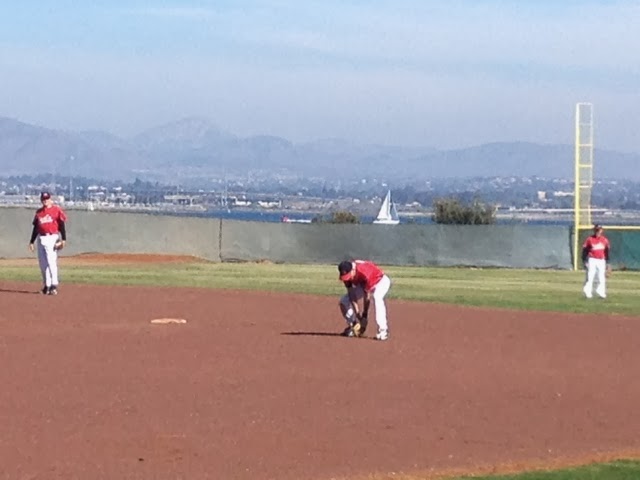
You see, on Sundays I have the honor and pleasure of working a very special amateur baseball league that plays its games in an unbelievably beautiful setting on Coronado Island in San Diego, on a gem of a field on a quarter-mile wide sandy strip of land known as The Silver Strand. It’s an age 55 and over senior league, but frankly most players are 60+ and many well into their 70s. The quality of play is no different than any amateur league in that in the end, the team that doesn’t beat itself usually comes out ahead – of course!   The guys take the game seriously, but there’s also no doubt they’re all well aware that the outcome is not as important as the gift of still being able to play baseball from the neck up the way they always have. What time has chiseled away from their athleticism, the heart has recompensed.  Sore limbs and aching muscles are usually no match for the will to hit, field, throw, slide, and yes, even dive for the baseball on occasion. But sometimes, too much is just too much, as it was on Sunday.  While working on a shutout in the 4th inning, after firing a strike, the pitcher took a woozy step off the mound, went down to a knee and collapsed. After the immediate attention from a few players with medical training and the extended efforts of the quick-to-arrive paramedics, about thirty minutes later, the gentleman was pronounced dead right there on the field. A life ended at age 57 on a pristine summer-like March day, under blue sky, the sailboats silently dotting the harbor beyond left field, teammates and opponents silently milling about the field. 


Shortly after the reality of the situation was apparent, players from both teams joined in a circle for the impromptu memorial and it didn’t take long for the sentiment to surface that the deceased died doing what he loved, and we should all be so lucky to go that way when our time comes. I suppose medical professionals see these dramas everyday but for me, it was sad, shocking and surreal to see a guy playing baseball one minute and lying lifeless in the next. You often hear stories about how life is precious, which I think we all know on one level, but on another, our awareness is dominated by the more practical matters that compete for our utmost attention. Indeed, it isn’t easy to maintain balance and keep everything in perspective. No, we can’t enjoy every moment, but we certainly should try to and, more than that, find the time to follow our passions any way we can. The thing that happened Sunday had nothing to do with baseball, but in some way, it had everything to do with it.


Please say a quick prayer for the pitcher, try to notice the beauty in each day, and if you’re ever visiting San Diego, stop by The Strand on Sunday and catch a few innings of some old-school baseball.
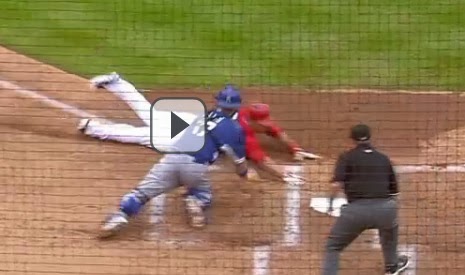
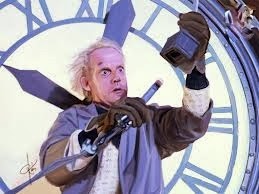
What’s not wrong with this picture? Mattingly did what?

Oh boy, is this instant replay stuff a ton of fun in the first few days of spring training! Today’s adventure involves a would-be inside the park home run and a close play at the plate prompting Angel manager Mike Scioscia to call for replay review.

Take a look at the play HERE.

There’s a couple of things I want to point out about this one.  Not to keep harping that the umpires get most of ’em right, it’s just that it’s not an accident.  If you read my previous post about the old saying, “ties go to the runner,” you know that this is half true.  Ties indeed go to the batter or any runner forced to the next base, but when the runner is advancing at his own risk, ties go to the defense. Read that post for the full explanation, but in regards to today’s play, if it’s not clear the runner got to the plate first, he’s out. Just like that great play Jeter made to nail Giambi at the plate so many years ago in the playoffs, it’s not a tough call for the umpire although it appears crazy-close. Look at it again, you can’t say the runner got there first, so he is still out.

The second thing I want to point out has to do with the question in the header, “what’s not wrong with this picture?” Although the announcer sums up the play after the review with a statement about home plate umpire so-and-so calling the runner out, that was actually the first base umpire making the call at the plate, that’s the part that’s not wrong. This is one of those misdirections that goes on routinely when umpires rotate to gain outfield coverage but nobody notices; and not that you have to, it’s just today’s lesson as part of the “baseball-rules!” curriculum.  In this situation, with the second base umpire going to the outfield to judge a diving attempt at a catch, the third base ump rotated to second, the home plate ump rotated to third for a possible play there and the first base umpire, after making sure the batter-runner touched first, rotated home for the unlikely but in this case, certain-to-happen close play at the plate.  And once again, the unbiased guy right on top of the play, stopped and set to get a good look, got the play right.  Trust me, soon enough, instant replay will show a wrong call and that won’t be an accident either; there will be a good enough reason for it.

Oh yeah, that question about Don Mattingly –  Did you know he was the last left-handed major leaguer to play second base?  Say what?  Yes it’s true!  The story behind that is an interesting side note to one of the most controversial games in MLB history and can be found in my book “The Rules Abide.”  It’s on sale HERE at the spring training special price of $2.99 for the eBook. Why the heck was Donnie ballgame playing second?  Share this to test those die hard Yankee fans out there!

Quick hit – Beer Goggles 0 for 3 in Instant Replay Debut

MLB history was made as the new instant replay system was put to the test in spring training games in Florida and Arizona. The first day yielded three challenges and I’m here to tell you that in all three cases, the calls on the field survived the video review by the desk-blue inside MLB’s NYC headquarters. As an amateur umpire, I’m not surprised the pros went 3 for 3, but I’m also not about to gloat. Professional umpires are not perfect; they all make mistakes on occasion, but
just not as often as you think, or should I say not as often as managers think.The new system is in place as a safety net, especially when the game is on the line, but I think it’s going to turn the table of scrutiny around on the managers who will be publicly proved wrong the vast majority of the time when they’ve marched on to the playing field certain they just witnessed a gross injustice…

This is the story – that the mind of a biased observer is convinced it saw what it wanted to see – but the impartial viewer saw something entirely different.

I’m going to call this the “beer-goggle” effect where the manager is the guy who had too many grape sodas and simply sees an imagined ideal more than the reality of the situation. This is nothing new, but the review process is, and that changes the whole dynamic of the classic manager-umpire relationship. In the old days, meaning last year, the proudly defiant manager would at least leave the field with the dignity of agreeing to disagree with the umpire after getting the benefit of the last word of the argument. Under the new system and protocol, when he is wrong, the umpires ironically will get the last word as the rebuffed Skip schleps off the field. The new system may yield the desired results but you can’t say it doesn’t tinker with the game’s DNA.

Check out the MLB videos by clicking HERE

…But the difference of opinion between managers and umpires is more than a psychological trick. With regard to the calls themselves, the plays involved a tag at second, a pulled foot by a first baseman as well as the oldest close-call in the book, a bang-bang play at first following an infield grounder. I have to say that the replays, at least the ones I saw, didn’t so much prove the initial calls absolutely correct as they proved to be inconclusive. Baseball can be the literal “game of inches” so without a view of the play from the perfect angle, it will often be difficult to tell conclusively if a tag was made or a toe just came off a base. Most players, fans and managers don’t realize that the professional umpires on the field stealthily adjust their positions in order to get the right angle and be stopped and set to get a clear look at a play while everybody else is busy doing their thing from a great distance or a poor angle. Sometimes an umpire will find himself in a bad position, just like a player might, and/or be blocked for an instant at the worst possible moment and the call might be wrong. Bad calls don’t happen for no good reason – yes, an intended double negative.This is why the safety net of replay is a good idea, but I think we’ll see that most of the time, the impartial observer with the closest view from the best angle gets it right.

Jim Tosches is an amateur umpire and blogger in Encinitas, Ca and author of the book, “The Rules Abide: The Thinking Fan’s Guide to Baseball Rules (With History, Humor and a Few Big Words)”

March Spring Training sale: ThE RuLes aBide” eBook just $2.99

CLICK HERE TO SEE REVIEWS AND PREVIEW BOOK

Here Comes the Future – Stats 3.0. – Baseball’s Dark Matter

Dark matter is the stuff in the universe we can’t see but, because of its apparent gravitational force on everything we can see, we assume it exists and that it influences everything.  As science advances, the deeper we can peer into the structure of the universe, the more we learn about how it really works. Quick leap – the same is true in baseball. Some people think the game is slow and that’s because either they aren’t aware of or simply don’t appreciate everything that goes on in the spaces in between the action. This is the stuff we can talk
about all day and that’s why we love the game, each pitch it’s own mini-big bang of new energy, after which all the elements regroup and no two circumstances are ever exactly the same. In my last post, I told you about a Sabremetrics course available at edX.org that will help us catch up on the modern interpretation of statistics that spawned the “Moneyball” revolution over the last decade. Just as you do that however, MLB announced that it will take baseball number crunching to the next level, where no man has gone before, with an effort to measure and record the spaces in between those spaces I mentioned. Let me explain.

Baseball has always been a game of statistics but the 1.0 kind were expressed in hard and fast scoring results: hits, runs, stolen bases, strike outs, etc. If I can make this nice and neat, this includes the first wave of “joins,” to use a database term, that conjured up things like on-base percentage by combining multiple known stats. I’ll call the “Moneyball” revolution “stats 2.0” where computing power enabled guys with advanced college degrees to merge data and create new ways of looking at a player’s value.This pretty much used the same information that was historically always available, but looking at it from a different point of view and creating a cause and effect relationship between what a player does and how it affects the team in the long run.

While Sabremetrics is scientific, there’s still an art to interpreting the results of so much data, but with the ability to dig deeper, science has given us “metadata,” data about data. This is the new frontier that baseball is pursuing with a new system that will measure every action on the field, stuff we previously couldn’t see, or more precisely, stuff we previously couldn’t measure, “stats 3.0.” How far and fast everyone moves, what their starting points are, how quickly they react to one thing in order to make another happen. This is the data related to the data that is hits, putouts, stolen bases, etc, – data about data. Regardless of the value that this information ultimately holds, we’re going to see the game in a new light. For example, a shortstop might make a great diving play, get up and throw a runner out and this play will be beamed around the globe in 1.21 gigawatt instant. The same ball might be a forgettable routine play for another shortstop because he positioned himself better, read the pitch, or perhaps just because he got a quicker first step. One could argue the guy who made the routine play is the better player, the implications of which are far reaching. The point is, as much as fans love dissecting every aspect of the game, there is stuff going on in the baseball universe that we still can’t see, and it influences everything.  And just like in the scientific world, launching the effort to inspect the universe doesn’t mean we’ll solve the mystery of it, only that we’ll have more information. That’s the science part, reaping the data. The real art however, is in how we use all this information to gain knowledge, which in my opinion generally holds true whether we’re talking about baseball or not. Here comes the future!

Here’s a link to MLB’s recent announcement about how they will introduce this baseball Hubble in a few stadiums this year and league-wide in 2015.  CLICK HERE

Jim Tosches is an amateur umpire and blogger in Encinitas, Ca and author of the book, “The Rules Abide: The Thinking Fan’s Guide to Baseball Rules (With History, Humor and a Few Big Words)”

March Spring Training sale: ThE RuLes aBide” eBook just $2.99

CLICK HERE TO SEE REVIEWS AND PREVIEW BOOK

Sabremetrics 101 – No, Really!

I consider myself a student of baseball, but I can’t really say I understand all that much about Sabremetrics. Sure, I know that’s what the book “Moneyball” was all about and that in the movie version, Jonah Hill’s fictional-Yale-educated-sidekick helped support Brad Pitt’s real-life-Stanford-educated Billy Beane in his effort to construct a 103-win Oakland A’s team in 2002 based on some funky stats…and well, that’s what Sabremetrics is, the use of mathematical tools to analyze baseball.

The word Sabremetrics comes from the acronym “SABR” which stands for The Society for American Baseball Research which is an organization created in the 1971 for really smart people who love baseball. SABR’s original charter however had much more to do with protecting the game’s historical record than igniting the eventual “Moneyball” revolution.  I suppose the first Sabremetric thought may have been decades ago when, I don’t know, maybe Bill Gates was in little league and he couldn’t hit a lick but one of his very smart parents had the thought, “a walk is as good as a hit.” That was just common sense – “a walk is as good as a hit” didn’t become a genius-level thought until someone finally realized “if you work a walk, you not only get a base but you’ll wear down the pitcher and guarantee that every Red Sox-Yankees game between the years 2003-2013 will exceed four hours…”

Where was I going with this?  Oh yeah, if you want to be a real student of the game, go to school! As a public service, I want to let you know about a college level course on Sabremetrics at the virtual school edX.org that is available to everyone:

Sabremetrics 101: Introduction to Baseball Analytics

The course will cover the theory and the fundamentals of the emerging science of Sabremetrics.  We will discuss the game of baseball, not though consensus or a fan’s conventional wisdom, but by searching for objective knowledge in hitting, fielding and pitching performance.  These and other areas will be analyzed and better understood with current and historical baseball data.

Learn more by clicking here. 

Go back to school…but don’t be Frank-the-Tank!

And speaking of the movie “Moneyball,” RIP Philip Seymour Hoffman, one of a kind…

Trick Play Call-to-Arms! Know your balks…

Trick plays in baseball can be a thing of beauty or “bush league,”  beautiful to the perpetrators, bush league to the guys who were fooled. The old hidden-ball-trick is genius in its simplicity and fair enough because there shouldn’t be any sympathy for anyone not keeping an eye on the ball, but when the misdirection becomes overly theatrical, its fair to say a line’s been crossed.  I’ve seen some surprisingly well rehearsed gadgets at the high school level here in San Diego, like the fake
pick at second where the middle infielders dive for the “wild” throw, so off line that even the outfielders sprint with their backs to the plate to fetch the rock.  Of course the pitcher never threw the ball and the poor runner, alone at second without a base coach, senses the mayhem, pops up and usually heads for third where he’ll find the third baseman waiting with the ball.  (See it here.) That’s a bit much for me, but I have one for you so simple, you’ll just have to try it and see what mayhem it might create…but it is completely allowed by the rules.
As you know from Balking-101, a pitcher can’t throw to an unoccupied base of course. Okay, easy enough.  But what about this?  With runners on first and second, three-two count, and two outs, we all know the jig, the coaches will warn the runners with the standard “make sure he goes home” advice and as soon as it’s obvious the pitcher won’t be spinning back towards second or going to first, the runners will take off.  What if in that situation, rather than delivering the pitch from the set position, Ace simply stepped and threw towards third? That’s a balk because you can’t throw to an unoccupied base right? We just covered that! You know this from a lifetime of participation in baseball right?  And that’s the beauty of it, because you would be wrong. The rulebook clearly states that the pitcher may not throw to an unoccupied base “except for the purpose of making a play.”  Buried in rule book case studies are examples of this that clearly point out that throwing ahead of an advancing runner is not considered throwing to an unoccupied base. This includes the situation I just described and also, a pitcher spinning toward second to make a move on a runner breaking from first. Now if the first baseman pretends to forget to hold the runner, inducing an early break like when a pitcher mistakenly starts from the windup with men on, and Johnny takes the bait, is that good baseball or does that cross the line?  Since the root of this move is validated by simple language in the rule book, I say it doesn’t cross the line.  
So let’s do it!  Let’s start trapping those runners who don’t know the rules.  Oh, and the mayhem I mentioned?  Well, I can’t guarantee the umps won’t call a balk, so they might, but then the coach could protest and yeah, confusion might reign down, but in the end, it won’t force in a run so I think it’s worth the risk to see how often it works.  I’m not trying to cause “reign” delays, my goal is simply to promote awareness of the rules of baseball.  So please forward this call-to-arms to all those players and coaches you know and please let me know what happens.

Jim Tosches is an amateur umpire and blogger in Encinitas, Ca and author of the book, “The Rules Abide: The Thinking Fan’s Guide to Baseball Rules (With History, Humor and a Few Big Words)”

CLICK HERE TO SEE REVIEWS AND PREVIEW BOOK

"A" is NOT for Abner. The Doubleday Doubletake…

In my last post, I giant slalomed through the gates of rule book logic to debunk the old saying that “the tie goes to the runner.”  Although we know the rule book is a living breathing thing which keeps evolving, like with last year’s change outlawing the old third-to-first spaghetti move, when you look at the proverbial forest through the trees, the rules make sense most of the time – much of which goes back to the original Kickerbocker Rules of the mid-nineteenth century.  As we salivate in anticipation of spring training games so we can again focus on the action, I thought it would be a good time to take a look back and tell you about another surprising myth about baseball.

I speculate in my book “The Rules Abide” that the very early baseball games must have been like backyard whiffle ball games where you make things up as you go: double in the trees, triple off Mr. Murray’s Buick, and so on.  I imagine that in the very first attempted baseball game, the hurler quick pitched the batter on the very first pitch.  After a pithy argument about pitching protocol, the second pitch probably buzzed Casey-at-the-bat.    –   “Bejabbers! If you knock the striker with that ball, he should ripple the current over to the first square as retribution”  –   Without regulations, everything was up for grabs because if there is one sad constant, it’s that if you ain’t cheating, you ain’t trying hard enough.  That is until someone decided it might be in the game’s best interest to put some simple rules in place to standardize a structure that would allow the game to play out in a fair and controlled manner.  That someone was you-know-who, Alexander Cartwright, the man officially recognized as the father of baseball.
Who’s Cartwright? “I’m Cartwright!”

What’chu talkin’ ’bout Willis? You thought it was Abner Doubleday?


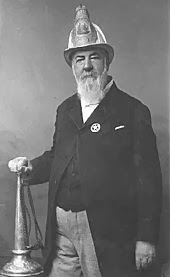
Most of us give credit to Doubleday as such, his name synonymous with baseball ever since a 1907 report, commissioned by the National League, which identified him as the founder of baseball. Doubleday however, a Civil War general from the north, never claimed to have invented baseball and no reference to the game was ever found in any of his letters or papers discovered after his death.  Cartwright, on the other hand, a New York fireman by trade, founded the Knickerbocker Baseball Club, introduced the first formal rule set, including the field layout, and organized the very first official baseball game, reported to have been played on June 19, 1846 in Hoboken, New Jersey where the “New York Nine” ironically trounced his club 23-1.  While the exact genealogy of baseball is subject to debate, The Knickerbocker Rules of 1845 signified that baseball had made the transition from an amalgamation of earlier folk games to that of a widely recognized and popular sport that would, as soon as 1856, be referred to as “America’s National Pastime.”  Over time, opinions among historians shifted and the tipping point came in 1953 when the United States Congress officially declared Cartwright as the “Inventor of Baseball.”  Next time you visit the Hall of Fame, make sure you take in some action at the beautiful Doubleday Field, named after Cooperstown’s own Civil War hero, but remember, “A” is not for Abner!

If you’ve come this far, please subscribe at top right to ensure future blog deliveries
Thank You.  

“Tie Goes to the Runner” Myth – Like Santa, it does and doesn’t exist!

Who hasn’t heard someone yell “tie goes to the runner” after a close play at first? Of course that plea is just another example of a fan grasping at the nearest cliché to rationalize a favorable outcome for his or her team, the offense. It’s a complex discussion to talk about all the factors that influence the call when it’s so close to the naked eye it can go either way, but what of baseball’s rule book? Since I’m in a debunking mood, let’s see what the rules say about TGTTR.

Before I start dissecting words, we need to remind ourselves of some of baseball’s inalienable truths. 

The object of the game is for the batter is to circle the bases and score a point. The defense’s job is to put the batter out. Sure, that’s obvious, but the underlying implication might not be – baseball is the only sport where the defense holds the ball so they bear the burden of proof to put the batter out. If we can expand on the legal analogy and say “beyond a reasonable doubt”, you’ll see where this is going. Heck, the batter can just stand there and do nothing, but if the pitcher can’t do his job and throw a strike, the batter wins the outcome. See how it works?


The first statement we need to study is in Rule 6, “The Batter.” “The batter is out if…he or first base is tagged before he touches first base.” Read this carefully: the batter must be put out BEFORE he touches first.

If our hypothetical batter is playing in an adult league and his day job happens to be a computer programmer, he might think of his dash to first like this, “I need to get there in time that is not less than the ball, which means greater to or EQUAL. Equal is good. Equal is safe!”

This Rule 6 declaration implies that when the batter-runner’s foot comes down on the bag the instant the ball pops the first baseman’s mitt…the proverbial “tie”…the runner must be safe because he wasn’t put out BEFORE he touched the bag. So that’s it – end of story, the rulebook supports TGTTR! But wait…

In the very first sentence of Rule 7, “The Runner,” the book says a runner [is safe] “when he touches it before he is out.” This is different. Now, as our weekend warrior programmer/slugger is trying to steal second, he is thinking “I need to get there in time that is greater thanthe tag. I need to get there first. Equal is bad. Equal is out!”

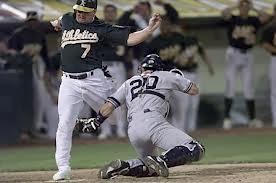
This logic seems to contradict the Rule 6 logic because now, the book is saying if he didn’t get there first, he is out. Why is the rule book so confusing? Actually, it’s not. Rule 6 is about the batter and Rule 7 is about the runner. The simple baseball truth is that once our guy reaches first, his time at the plate is done, and now, the burden of proof is on him to move safely around the bases, at his own risk, beyond doubt. Rule 7 clearly says he has to touch the base BEFORE he is put out. This is beautifully illustrated in the infamous play Derek Jeter made in the 2001 playoffs vs. Oakland where he ranged all the way to the first base line to cutoff an outfield throw and backhand the ball to catcher Jorge Posada. Jason Giambi was caught off guard so he failed to slide and Posada slapped the tag down just as Giambi stepped on the plate. To the naked eye it looks like a tie.  In real time it’s hard to say what happened first, the tag or the step on the plate. What is clear however is that Giambi didn’t get there noticeably first, before the tag. When you look at it like that, he was clearly out on a play that seems like it could go either way. This was an unbelievable defensive play and a great call by the umpire. The Rule 6 & 7 statements tell us that in the end, the tie goes to the batter, but not the runner.  But wait, there is still more…

There is a third reference like this, also in Rule 7, “The Runner.” It says, he is out if he…”is tagged before he touches the next base, after he has been forced to advance by reason of the batter becoming a runner.” If the runner is being pushed up, i.e. forced, then just like the batter-runner, the benefit of the tie-doubt swings back to him.  This makes total sense and solidifies the idea that when the ball is put in play, the burden is on the defense to be first to the punch, but if a runner is advancing on his own, he must win the race. When we piece these three rule book statements together, the logic is consistent and shows remarkably how proper baseball’s rules really are.  

This analysis simply tells us what the underlying rules of baseball say, but doesn’t guarantee a thing as far as how the game is officiated on the field. Certainly Jeter’s effort had an impact on the arbiter’s decision in that instant he made such a memorable play.  Regardless of the appearance of any play, an umpire has to make a call one way or the other, so ties can’t really exist in outcome, although they can in space and time. In that respect, ties in baseball are indeed like Santa Clause, they do and they don’t exist. I’ll address how this plays out on the diamond in an upcoming segment but in the mean time, remember, ties go to the batter, but not the runner – in theory.

Jim Tosches is an amateur umpire and blogger in Encinitas, Ca and author of the book, “The Rules Abide: The Thinking Fan’s Guide to Baseball Rules (With History, Humor and a Few Big Words)”

Click HERE to see reviews and previews of Jim’s Book

MLB approves pitcher headgear – Duh! Now let’s strip hitters…

Give me all your fearless X-gamers, base jumpers and assorted adrenaline junkies inventing new ways to get hurt and there is still no more dangerous and nerve-wracking job than pitching a baseball with the suppressed reality that in an unexpected instant, you might not be able to prevent a liner from hitting your skull at 100+ mph.  
It’s amazing Tampa Bay pitcher Alex Cobb came back last year to go 5-1 down the stretch after being hit in the head by a line drive in a June 15th game versus the Royals.  He “only” suffered a
concussion but still required two months of rest and rehab to courageously get back in the game.  Many others, amateur and professional alike, have not been so lucky so it seems like a real “duh” moment to tell you that MLB will be testing protective headgear for pitchers in a few weeks, once spring training starts.   The company isoBlox is making a padded insert that will be sewn inside caps  – it will look like the pitcher is wearing an oversized cap.  This is a case where function is more important than form so all we can say is “it’s about time” seeing how hitters have been wearing hard lids since 1940.
This got me thinking about the delicate balance in baseball between the hitter and pitcher and how “progress” has tipped the scales towards the batter as they’ve been bulking up at the plate, in more ways than one, for decades. Traditionally, the war is fought on the battle ground that is the inside part of the plate – who hasn’t heard the saying “pitch in to win?”  This is as fundamental to the game as using a stitched ball, but in the name of player safety, baseball has allowed hitters to come to the plate looking like extras from “Mad Max.” With hockey style elbow pads, wrist guards and the like, along with a lessened fear of getting plunked, these guys gain a confidence and plate coverage that defies the natural laws of baseball’s seminal confrontation.  While a bean ball to the head should always be severely punished with ejection, fine and suspension, it is supposed to hurt a little when hit on the body with a pitch – there is supposed to be a price to pay. From little league on up, this healthy respect for the pitch makes hitters share the road accordingly, but not so much in the bigs anymore.  In fact, some guys lean in so much, the HBP becomes a strategic part of their game. And God forbid if it appears they indeed got plunked on purpose. Then it’s “Houston, we have a problem.” The offended might start jawing his way up the line, the umpire might issue a warning but then it’s a near certainty, the whole game has to stop while the insulted batter dramatically scorns, tugging those velcro straps to remove and pass off the requisite accoutrements to their attendant valets. Geesh! 
Look, I’m not completely heartless so I’ll let hitters keep the foot and shin guards, but how about we make a rule that says no protective gear on the hands and arms other than batting gloves.  And how about we make another rule that says anyone who charges the mound, leaves the dugout or bullpen gets a 25 game suspension?   Oh I know, it’s no fun getting hit by a baseball so how about we say that if a batter gets hit by a pitch, as a reward, he gets a free pass to first base. Call me crazy!

Jim Tosches is an amateur umpire and blogger in Encinitas, Ca and author of the book, “The Rules Abide: The Thinking Fan’s Guide to Baseball Rules (With History, Humor and a Few Big Words)”

Click HERE to see reviews and previews of Jim’s Book

MLB Replay – Part III – How will it work?

In my first two blog entries on the subject of MLB’s expanded use of instant replay (IR) beginning this season, I argued that while IR might be the greater good, it comes at the expense of some of baseball’s unwritten rules and traditions.  Hardcore baseball fans can debate this all day long like they might the Pete Rose hall of fame issue; traditionalists don’t want to tinker with the game while techno-geeks won’t be happy until balls and strikes are called by nuclear powered hover-bots.  As the debate rolls on, lets look at the specifics of how IR will be implemented as it has some interesting components…
  • Monitor – Each team will have an employee monitoring video in the clubhouse who will communicate with the dugout via phone.  No additional technology is allowed, e.g. monitors in the dugout.  All stadiums are to have similar video camera setups and it is assumed that video from both teams’ feeds are available.  How can I get this job?
  • Challenge – Once tipped off by the team official, the manager starts out with one challenge per game, but maybe a second one too.   If the call from his first challenge is reversed in his favor, he is awarded a second challenge for a maximum of two. You could say this adds a strategy element to the manager’s job, but I don’t see any manager passing up an opportunity on the very first close call given the next IR standard operating procedure…
  • Safety Net – From the 7th inning on, the crew chief has the authority to request a review. This is the safety net for any questionable call late in the game after the managers are out of challenges, ala the two-minute rule in the NFL.  This is interesting because managers will still argue calls but since that rarely works, will quickly press the ump to go to the replay.   If the umpires take the traditional stance that their judgment is final, what will it take for the crew chief to fire up the replay?  This is a weird dynamic – we’ll have to see how it plays out.
  • Exceptions –  Most plays other than balls/strikes can be reviewed, but not all.  The highest profile exception is the double-play turn at second base with regards to the base touch, the “neighborhood play,” the time-honored tradition of giving the benefit of the doubt to the middle infielder if he is slightly off the base while trying to avoid a takeout slide.  Other exceptions are obstruction, interference, Infield Fly Rule calls and check swings.  If you’ve read my book, “The Rules Abide: The Thinking Fan’s Guide to Baseball Rules (with History, Humor and a Few Big Words)”you know that the rule book does not define a swing and defers to umpire judgement, (“did he strike at the ball?”) to determine check swings.   Judgment is invisible on video!
  • Bunker Umps – The final decision will be made by umpires at work within MLB’s NY HQ.  The field umps have no say in the review.  This represents a giant change in the dynamic from the umpires getting together to overrule one of their peers right there on the field.  Ok, this is really the job I want –  umpiring from a desk using super slo-motion video replay. Where do I sign up?!
  • Transparency – While this is going on, stadiums will be allowed to show the replay on their big video boards.  While you can argue something is lost with IR, this adds an element of anticipation and excitement similar to what you see in NFL games. 

The length of baseball games is always an issue but I think we’ll find these challenges are handled quickly.  Umpire meetings/discussions usually take several minutes, as did the one in game one of last year’s world series, but the replay showed the call was obviously wrong.  With video, there is not much to debate, either it is “clear and convincing” (league language) or not.

Personally, I think MLB got this right by limiting the delays by the managers, but empowering the umpire crew late in the game.  One result of IR I’m predicting is that by placing the umpires under technological scrutiny, magnifying their errors, we’ll learn ironically just how good these guys are – they’re right the vast majority of the time.  That said, when the IR system was tested in the Arizona fall league last year, during a week’s worth of games, out of 15 challenges, 3 were indeed overturned. It should be fun to watch this play out!


Jim Tosches is an amateur umpire and blogger in Encinitas, Ca and author of the book, “The Rules Abide: The Thinking Fan’s Guide to Baseball Rules (With History, Humor and a Few Big Words)”

CLICK HERE TO SEE REVIEWS AND PREVIEW BOOK